Last time I wrote a little on product placement:
”dont tell me how to live my life
a quote from my niece who is 8
Obviously I spent most of the time of my previous article on tangents – and the potentially limited interesting parts were dotted about in off hand comments and observations.
If you wanted a succinct history of product placement, you could always use an AI prompt, and it will summarise the subject into key areas and bullet points for you – so you can try and memorise the boring facts like some kind of textbook.
I suppose my writing is the antithesis of AI.
A sprawling mess of human thought, meandering through the writing process, dragging the reader on the journey kicking and screaming.
Occasionally something might be of interest along the way.
Which reminds me a lot of my commutes to London.
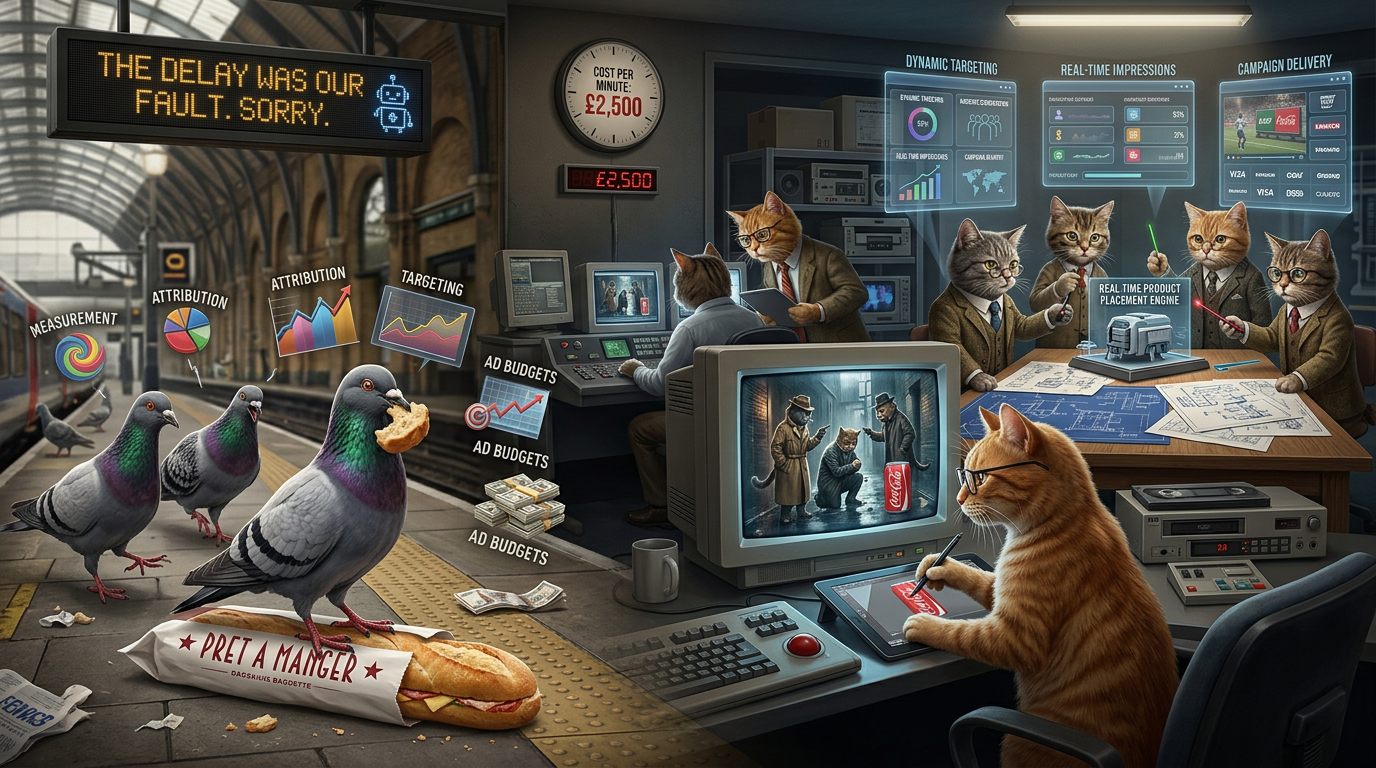
Painfully and long, and yet occasionally you’ll see a pigeon eating a discarded Pret baguette.
The sight being of interest as you watch the pigeon living his best life in that moment.
You think how simple his life enjoying this oversized treasure dropped by a traveller.
Perhaps being a pigeon isn’t so bad?
Then you see 3 more pigeons approaching with neck rocking malice.
How difficult his life is about to become in about 20 seconds…
Then a train robot announcement begins apologising for a delay. You realise you hate robots apologising and know that both you and the pigeon are about to have a crap day.
ah I’ve gone off again haven’t I? AI and pigeons distracting my thoughts.
I wonder if it says more about me, or the time in which i now reside.

Speaking of a time in which I reside, Or at least slightly before my time:
In the early days of VFX, Digital compositing used to be an expensive dark art at the end of a post production pipeline.
Usually reserved for films and expensive TV shows, you would have to book a suite costing 1000’s per hour to digitally composite images together. The software and hardware bespoke to the system and both prohibitive in terms of cost and skill.
Moore’s law eventually outpaced the hardware component, and companies like apple pushed the user/product component along side the hardware.
Small companies would make advancements in a difficult areas of compositing – normally only available to Giants like Industrial Light and Magic, then these advancements would get bought by vendors and distributed into their core products.
As an example, tracking an object into a scene used to be a manual and extremely difficult process, fraught with quality and difficulty issues.
(Im sorry if I gave anyone PSTD with point tracking memories)
X – Corner Tracking point
Then a company would come along, in this case Imagineer, who created a solution for planar tracking. Making it possible for anyone to track an object into a scene.
This tech then acquired by Boris FX and made available in off the shelf tooling like After effects.
This happened all over the industry. Tech and hardware advancements slowly becoming toolsets for the pro-sumer.
As time progressed, a Flame suite costing 1000’s per hour, could be replicated with off the shelf software and local PC hardware – and compete with most of the industry.
Eventually education establishments started to cater to this demand.
This meant anyone one with a passion could learn and create compositing and VFX from home.
Or perhaps, someone who couldn’t be bothered to go to university to do something boring like reading history, but also didn’t want to go and work in the local kitchen could learn to work in TV and film – surely this would be as fun as simply watching TV?
As a result, the market for digital compositing exploded.
The idea of putting advertising into a video after its filmed suddenly became a possibility as more and more people thought about the idea that you could do this.
Quite a few companies were created in the 2010’s to service this need.
One of which I Joined – and the mission was to make this format mainstream and become a Virtual Product Placement leader.
I was fairly naive at the time – as was probably most people wanting to transact this format..
It all sounded easy to me. We just composite a product into a show and that’s that.
make millions, everyone loves it. Cheat code activated, start pointing money.
After all there are so many benefits over Traditional PP

Its an un-skippable ad.
Its inside the content when people are “leaned in”.
You’re not stopping what people are watching to show them an ad and risk resentment and frequency hate.
Doesn’t mess with the editorial of the story. You can move it to scenes where actors aren’t in shot to avoid rights.
And a show with a realistic placement might help sell the realism of the show.
Us humans are great at spotting odd things in life that are life like but not real (uncanny valley)
Having realistic adverts subconsciously helps us identify with both the character and the locations.
You can probably think of some locations are even identifiable by their ads – like time square.
(Image of Time square with no ads)
Even with all these, Virtual Product Placement (VPP) / Digital Brand Integration (DBI) / In Content Ads (ICA) still has many drawbacks. Ive seen these first hand:
Many people rightly questioned – how do you measure this? How do you price it? Hell, how do you even deliver it with the operationsal complexity required?
The format more often than not go put into a special advertising bucket. Not your general advertising bucket with millions of budget, but a smaller slice for experimental budgets – You know the kind – they create a VR experience or hand out drinks if you can kick a ball into a net.
This isn’t where the format can live if its to be a success..
Along came AVOD and FAST and Mid rolls are now an inventory type that publishers are push more and more.
Suddenly fill rates are failing because there isn’t enough demand. Companies then start to realise – Hey, how come google and meta are making stacks? And they look to the Small to medium businesses..
A book called the long tail by Chris Anderson explains this in more detail, but essentially, SMBs offer very small but almost infinite revenue – if you can target them AND meet them at thier pricepoint.
How does a video distributor now move into this space? Well they enable the long tail. Something some of the smarter companies are trying to enable for inventory. Even the trade desk have realised the significance. They are currently still struggling with the pricepoint problem and hoping AI can help them.
Where do Virtual product placement companies sit now?
Well you have a format that doesn’t sit with how its bought and sold, it doesn’t enable targeting, its expensive and its generally incompatibles with most transaction systems.
Even still – people get it and love it.
Along come the IAB – and say that “In-Scene” IS a legitimate format – Its just hard to do and nobody seems to have nailed it yet to the standard that other CTV formats have, and as such, the adoption isnt as large as you would expect.
“Rock music suddenly kicks in – there is a crash zoom to our adStripe logo”
This is what we’ve been working on. We have created an advertising middleware layer that sits seamlessly across distribution stacks. It delivers Real-Time Product placement into a distribution endpoint – with all the bells and whistles of modern requirements like targeting, measurement and at a priepoint that would make google smile. Oh and IAB compliant.

God that sounds sales-y doesn’t it? I’m not a massive fan of the spiel, but I am a fan of the tech – and this is some seriously clever tech. I would say that, I was on the team that created and patented it. Obviously I’m biased, and clearly the tech people in the team did the hard yards while I simply chimed in with my stupid distracting comments adding delays and annoyance. So glad the team are tolerant of my shenanigans.
Was this article another long sales pitch? (Yes)
Was it interesting enough to warrant a sales pitch at the end? (No)
Are you going to have a look at our tech and potentially reach out? (Please do)