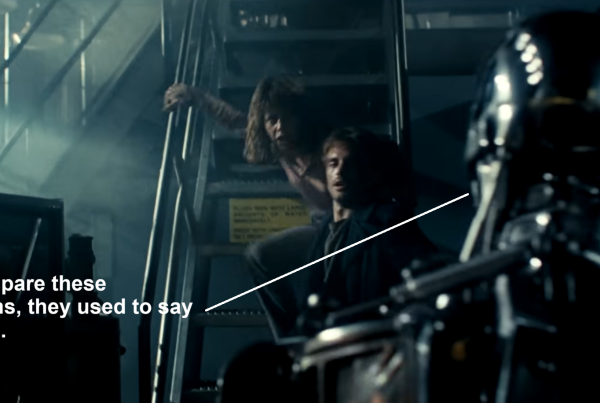
”...No
Wow wasn’t that easy? End of article. No AI required to help, which probably saved tons of sea water and spared a few fish.
Actually, that’s a lie, I have used some AI research in this article. Which means I have recklessly murdered at least 2 or 3 fish in the process. Fish with families. Fish with hopes and dreams. Fish that woke up this morning and spent the day looking forward to seeing their estranged fish family and fixing the fishy rift in the family that has been there for several fish years. Then out of nowhere – DEAD.
And actually, if you’re reading this, it makes you an accomplice. Which is actually worse isn’t it? You’ve stood by and let those poor fish die. And for what? So that I can fact-check my own drivel for a mediocre article on product placement?
And if you think you can be clever and just stop reading now, there’s no use. It’s too late, the damage is done. Those fish are without water, which makes them homeless. Which also makes them the opposite of drowning. Not drowning?
Which for a fish, is very serious business indeed.

To be honest, I’m not entirely sure how fish water converts into AI. I dare not use AI to find out more. It’s probably very complicated and I wouldn’t understand it without dedicating a good portion of my life to it. Which segues nicely to product placement, which is something I have dedicated a good portion of my life too.
I suppose we should start at the… start. Yes, that seems like a good idea. So product placement, what is it?
Well, making films is expensive. The average price to make a Hollywood blockbuster now is 100 million dollars.

This number, to my simple human brain is a little bit absurd. These are the kind of numbers that come with thoughts like, “They probably have very good lawyers” and “I bet they are very tax efficient, not tax evasive.”
These numbers are global corporation entity numbers and this is why films are not only a creative medium, but an investment vehicle. There is a reason why successful directors and producers are used time and time again. They are a safe bet to grow the investment into a profit and not waste it on additional unforeseen ‘business’ costs like having to reshoot scenes.
There is a whole studio system around making sure that companies investing in a film get the return they’re expecting. Pre-production, production and post, it’s all handled with ruthless business-like mentality and efficiency.
And, ladies and gentlemen, where there exists a business, there exist entrepreneurial possibilities… (AKA making some extra money.)
Product placement has been around since the beginning of film – as early as 1896. As mind-boggling as that date is – 130 years almost – less mind-boggling is the need for it.
It’s relatively simple:
A studio wants to invest in a film to make money. They need money to invest in the film and instead of risking all their own money, they ask for money from a brand who has money. In exchange, the brand gets to be part of the film. The studio then doesn’t need as much money to make money. How simple! Surely it can’t be too complex?
Well, it often is. The complexity comes in the implementation.
How long does the brand have to be on the screen?
Does it have to be in the script?
Will it be part of the story?
How many people will see it?
How will it look?
Will the brand need to be reshot because it took so long to come to the big screen that technology is outdated? How long on screen again?

image thanks to MOVIECLIPS.com (in case you cant see it!)
All of these questions act as a barrier to the studio and brand coming to an agreement. However, where there is a will, there is a way. In other words, where there is cold hard cash to be made, people will sit together at a table over dinner and work out the details. Those details can be as simple as slapping a coke can on a table seen in the latest Stranger Things (netting them 27 million) …

… or as complex as a 3 minute modern electric car-chase advertisement woven into the story with sales commentary like “Look at that cornering, it seems so effortless” delivered without a laugh from the actors. Obviously I’m talking about one of the most popular and well known English spy films ever to contain product placement:

courtesy of Universal studios.
Oh crikey! Would you look at that? This article is MASSIVE!
And when I say massive, I mean it in purely in the context of our current informational age where we are kept scrolling on social platforms, with content delivered continuously in small batches in order to keep the dopamine hitting and then having an ad delivered in order to maximise advertisement engagement. Now that Ad model is WAY more insidious that product placement if you ask me…
Either way, I want to start writing about newer forms of Product Placement i.e. those now done in Post Production – dubbed In Scene ads by IAB, Virtual Product Placement (VPP), Digital Brand Integration (DBI) or even In Content Ads (ICA). However, that will have to wait for next time.
I will tell you about why more modern implementations of Product Placement are lacking and how we’re solving it with our Real Time Product Placement™ solution that we have developed at adStripe.ai.
Yes, this whole article was actually a plug to our new technology. You should have known this was a bit fishy, having all this ‘amazing’ content for FREE? Oh well, it’s all water under the bridge now though isn’t it? If there is any left after AI.
Stew